FALCON·PEST CONTROL
Program Proposal · Prepared June 2026

A pest program
built by an entomologist —
for Towne Storage.

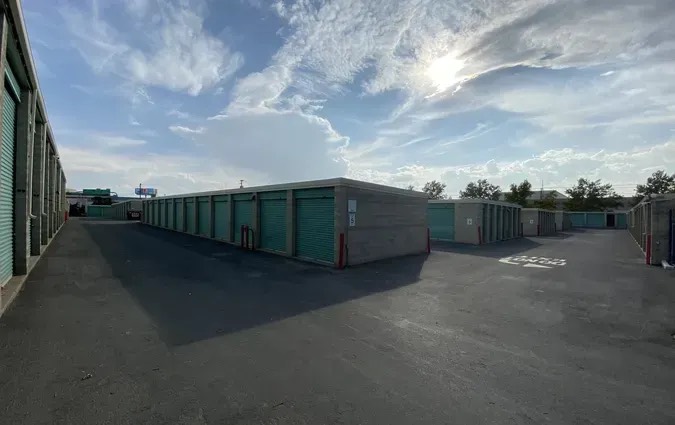
Riverton, Utah · 12367 S Pasture Rd · ~24 buildings, 48 exterior stations

Rodent Treatment Program Black Widow Remediation Gopher Control Full Transparency Portal

Prepared by

Trenton Frazer, MS
Board-Certified Entomologist · BCE #B3413
Mountain Supply LLC dba Falcon Pest Control
1648 Man O War Dr, Bluffdale UT 84065
(385) 412-9660 · trent@myfalconpest.com

Prepared for

Towne Storage
12367 S Pasture Rd, Riverton, UT
Corporate: Josh · On-site: Myrna

UDAF Applicator #4001-16378 · UDAF Business #4000-000021793

A note before the numbers

Myrna and I walked your property together. What I found is straightforward to fix — but I want you to see it before you see any numbers, because the photos explain both the problem and the price better than I can in words.

Your stations are sitting empty of bait, or holding nothing but stale, unpalatable blocks — and that alone is doing more damage than it looks like. I'll show you exactly why in the next two photos. Everything here is month-to-month: no setup fee, no minimum term, cancel on 30 days' notice. If anything reads off, tell me before you sign and I'll make it right.

Trent Frazer
Board-Certified Entomologist · BCE #B3413
§1 · Where you are today

The stations aren't
controlling rodents.
They're breeding spiders.
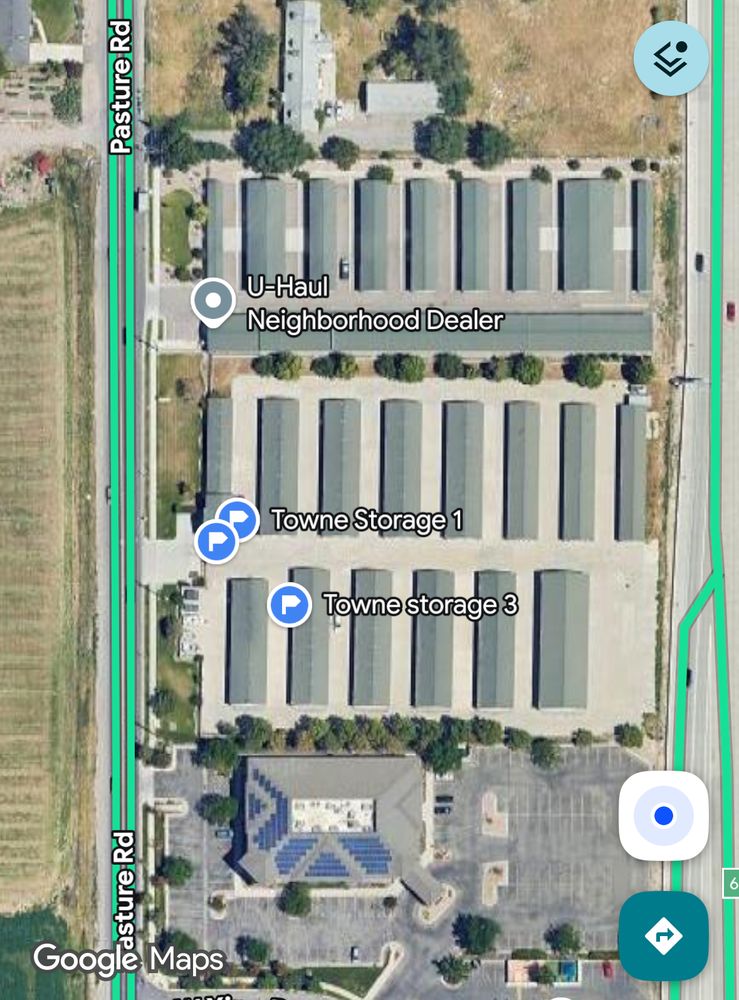
Aerial view of Towne Storage, Riverton
Towne Storage · Riverton, UT
Two long rows of buildings — roughly 24 in all — bordered by open agricultural fields. That field line is a constant source of rodent and spider pressure, and it's why the program is built around 48 perimeter stations.

This was the second station I opened on your property. It tells the whole story.
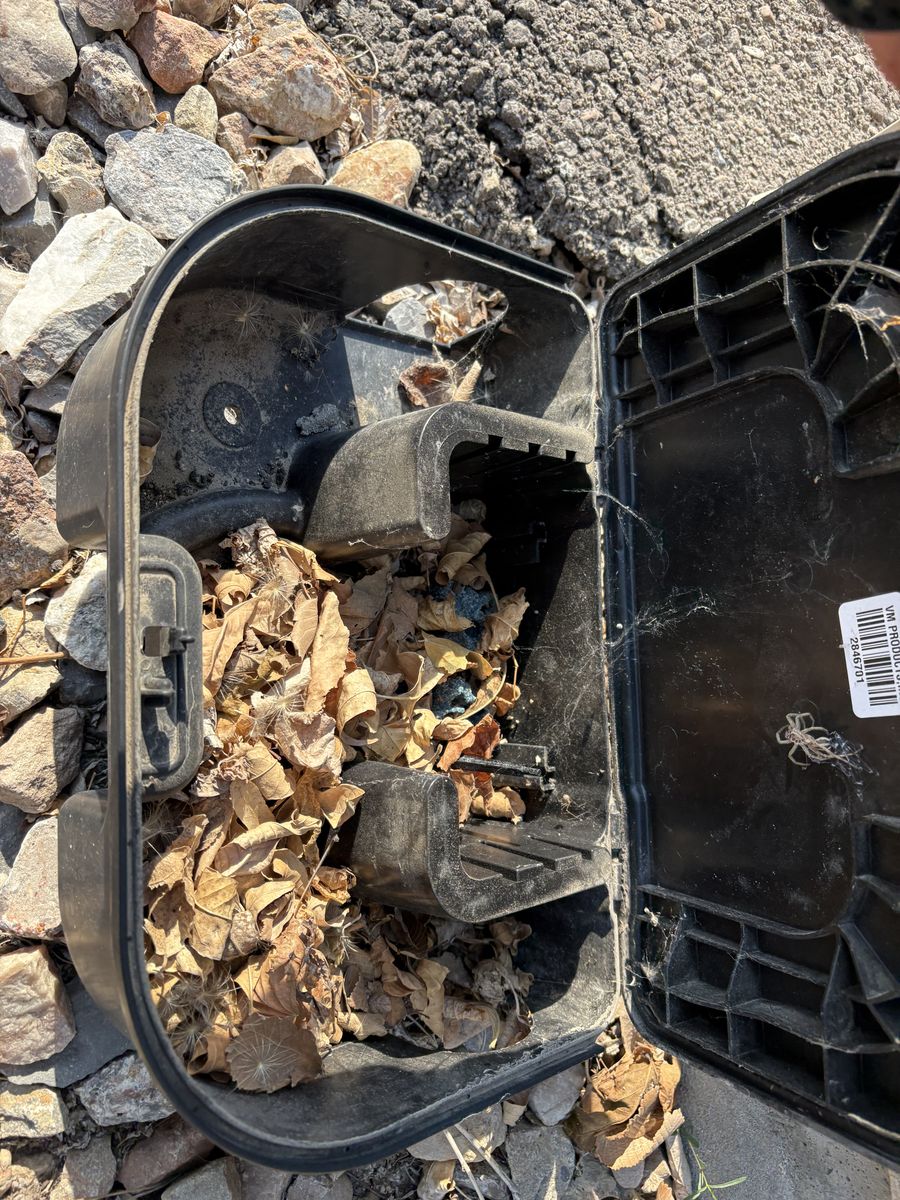
Open bait station packed with leaf litter and degraded bait
North row · station opened on inspection
Packed with dead leaf litter and stale, unpalatable bait blocks degrading in place. A station in this condition isn't feeding rodents — it's a dry, sheltered cavity that protects them, and it's ideal harborage for spiders.
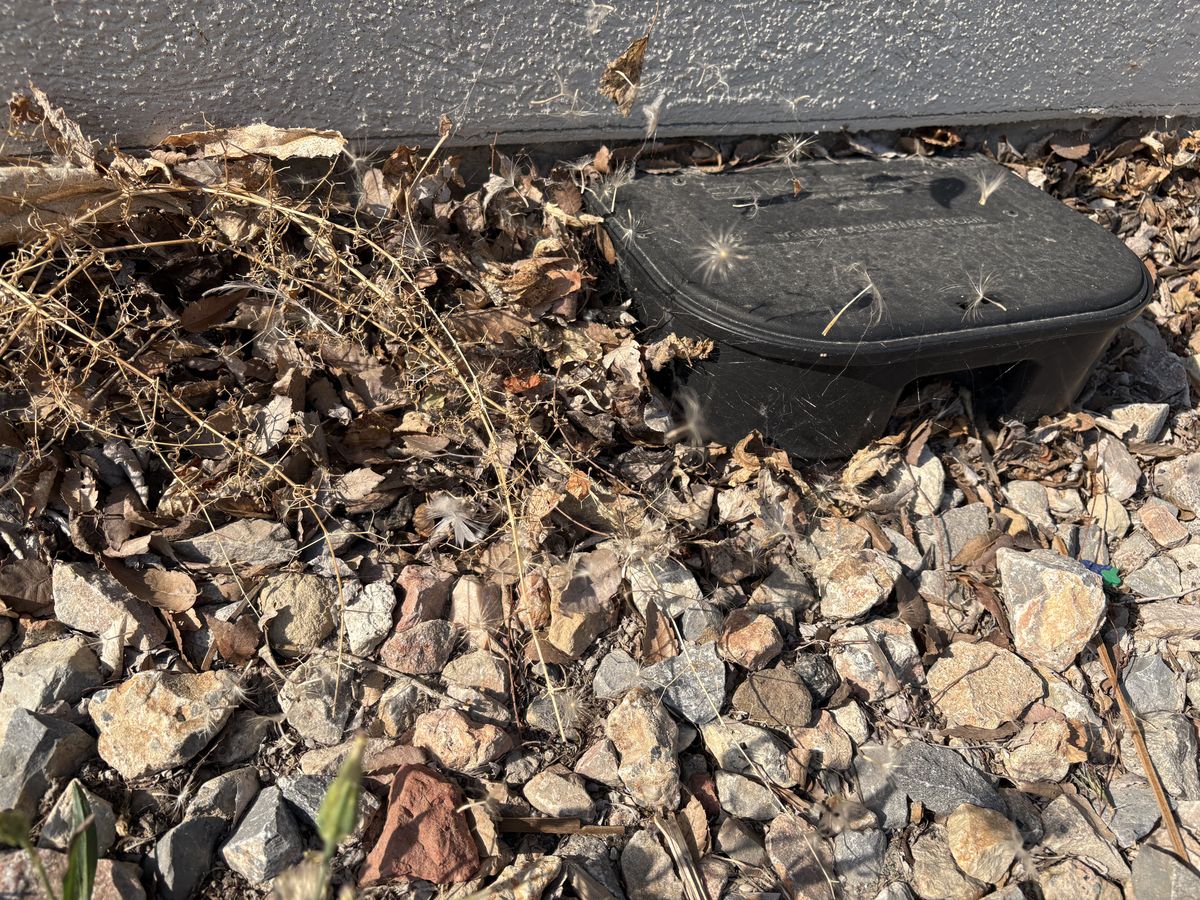
Closed bait station sitting in leaf debris and gravel
Same neglect, station after station
Debris drifted in around the base, webbing across the lid — this one plainly hasn't been opened to service. The bait inside has no value as control.

You don't have a rodent problem and a separate spider problem. The large black widows your team is finding inside the units aren't a coincidence — an unmaintained bait station is one of the best black widow harborages on a property: dark, dry, protected, and undisturbed. The neglected stations are actively driving the spiders. Fix the stations and the widow population collapses — that's the program.

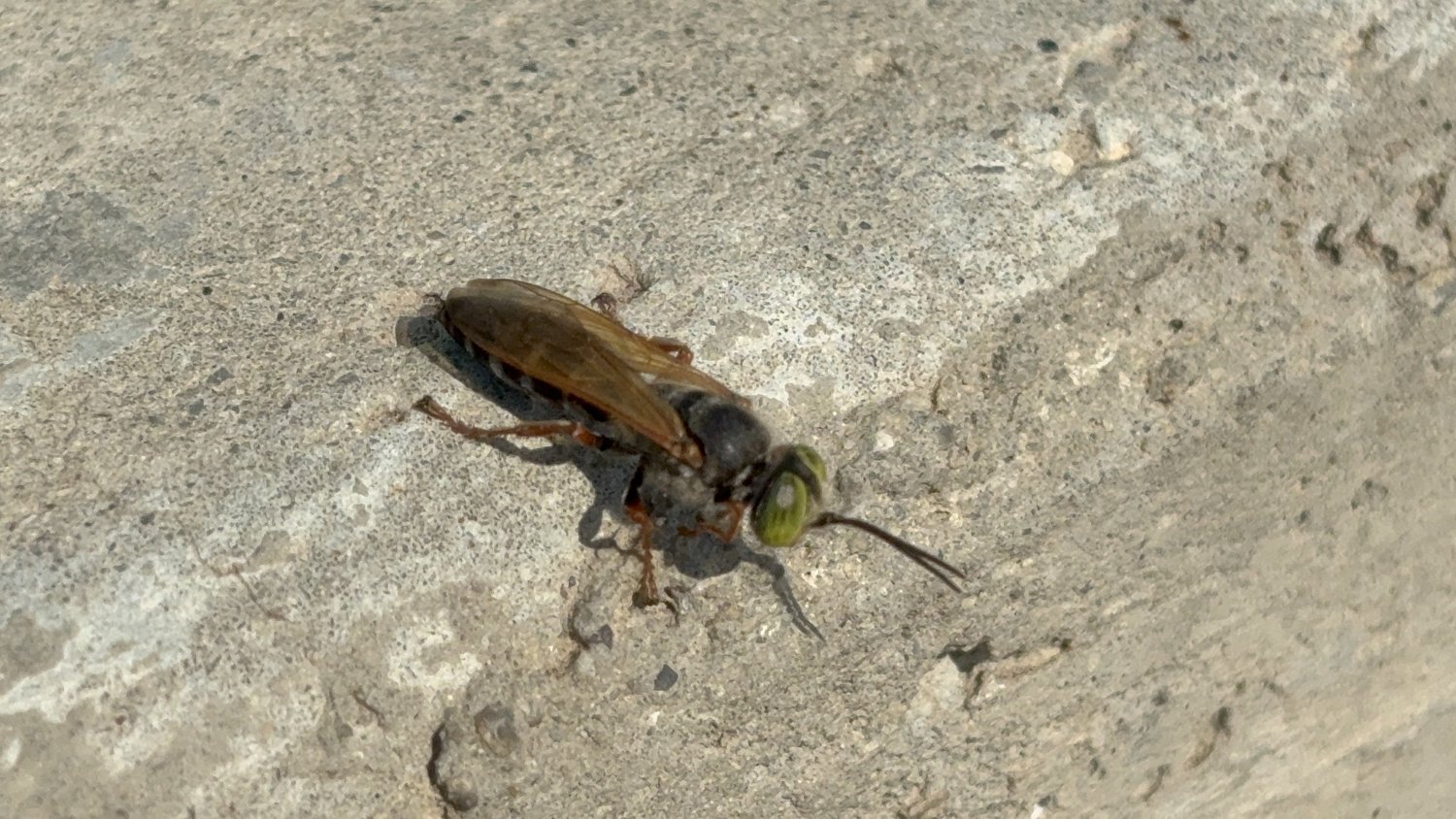
There's also an active gopher problem along the grounds, and a sand wasp colony I identified in the southeast corner — I'll come back to that one, because it's a good example of how I'd rather save you money than bill you.

See it for yourself

The widow harborage I'm describing — straight off your property:

Black widow · filmed on your property

What Falcon does on day one

  • All 48 stations pulled, replaced, and re-set with fresh bait — free of debris and degraded blocks.
  • Each station is photographed, numbered, and GPS-tagged, so there's a dated record of its exact condition and location from the first visit forward.
  • A full black widow treatment goes down across the property perimeter and unit fronts to knock the population back.
  • We remove your old company's stations at no charge if they don't want them back — one less thing for you to coordinate.
§2 · The program

Rodent Treatment Program
48 stations · pricing that follows the data.

We start monthly for the first three months to establish a true baseline — right now your stations tell us nothing, so the first job is to learn what's actually living on this property. From there the program becomes dynamic: the cadence steps down as the data proves the population is under control, and the monthly bill steps down with it. This is the part no traditional company can offer, because they have no data to justify charging you less.

Start here
Monthly · baseline
$349/mo
First three months and any time pressure runs high. Full service of all 48 stations, every month.
Bi-monthly
$205/mo
Once the data shows the population easing. Same coverage, stepped to the pressure.
Quarterly · floor
$160/mo
The lowest cadence we'll run. Stations are still cleaned and re-baited every quarter — which is what keeps the widows from coming back.
"Why wouldn't you just keep us at monthly and collect the higher rate?"

It's the right question to ask any pest company — so here's the honest answer. Because my credential is on the line, and because you can see the data. Every cadence change is logged the day it happens with the consumption numbers that triggered it, and summarized in your quarterly BCE report. If the pressure stays high, the data will say so and we'll hold at monthly — and you'll see exactly why. The transparency is the guarantee. I can't quietly overcharge a program you're watching in real time.

Step downConsumption at or below 10%, held two cycles → cadence drops one rung, bill drops with it.
Step upConsumption at or above 75%, held two cycles → cadence steps back up, we treat in kind.

Pre-authorized in both directions — I won't chase you for sign-off every time the data moves. Why 10% and not zero? A property bordered by open fields always carries some ambient pressure; 10% is the honest signal that the resident population is controlled.

Black Widow Remediation

Spiders are less responsive than rodents, so the strategy is different: hit them hard once, then hold the line. A deep initial treatment of the full perimeter and unit fronts, a follow-up at 30 days to catch the next hatch, then a quarterly maintenance spray through the warm season — spring, summer, and fall, skipping winter when they're dormant. The quarterly visit also clears any accessible paper wasp and mud dauber nests at no extra charge.

Initial deep treatment
Full perimeter + unit fronts — knock the established population back hard.
$349
30-day follow-up
Catches the next hatch before it re-establishes.
$215
Quarterly maintenance spray
Spring · summer · fall (no winter visit). Includes accessible wasp knockdown.
$215per visit · 3×/yr

Carve-outs, billed separately on approval: yellow jackets, bald-faced hornets, and any wasp nesting inside a wall void, crack, or other concealed space that can't be reached from an exposed surface. Accessible paper wasps and mud daubers are handled inside the regular service.

Gopher Control

Handled as separate jobs, not part of the monthly program — the work ends when the animals are cleared.

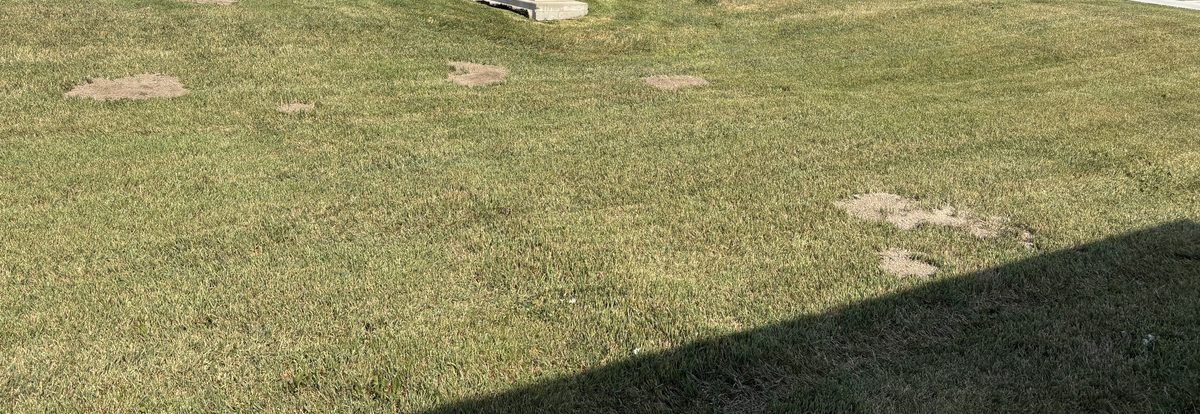
Initial assessment & treatment $345, follow-ups $215 each. A typical knockdown runs $560–$775, depending on how active the systems are.
Active gopher mounds across the front lawn
Front lawn · active gopher mounds
Bare soil mounds across the lawn are surface signs of an active tunnel system feeding on the turf roots below.
The difference you can't buy elsewhere

When you hire Falcon,
you hire an entomologist.

Here's a real example — it happened on your property, the day I walked it.

Sand wasp photographed on the property
Southeast corner · identified on-site
A sand wasp — solitary, non-aggressive, and actually beneficial. Not a colony-builder, not a yellow jacket. The kind of find that's easy to panic over and bill for.

In the southeast corner I found a sand wasp colony. With a traditional company, that's a phone call, a dispatched technician, and a line item — you pay for a truck to roll out and spray.

Instead, I showed the Assistant Manager what they were, explained that they're harmless and self-resolving, and walked him through how he could knock them down himself with a can of wasp spray and a hose. No billed visit. No truck. No charge.

That's what a credential one phone call away actually buys you. When something shows up between services, you call me — and a lot of the time I can tell your team how to handle it on their own instead of sending an invoice. No other pest control company is built to do that, because their model depends on the truck rolling out.

Sand wasp · filmed on your property
Falcon Community Command

You will never have to
take my word for it.

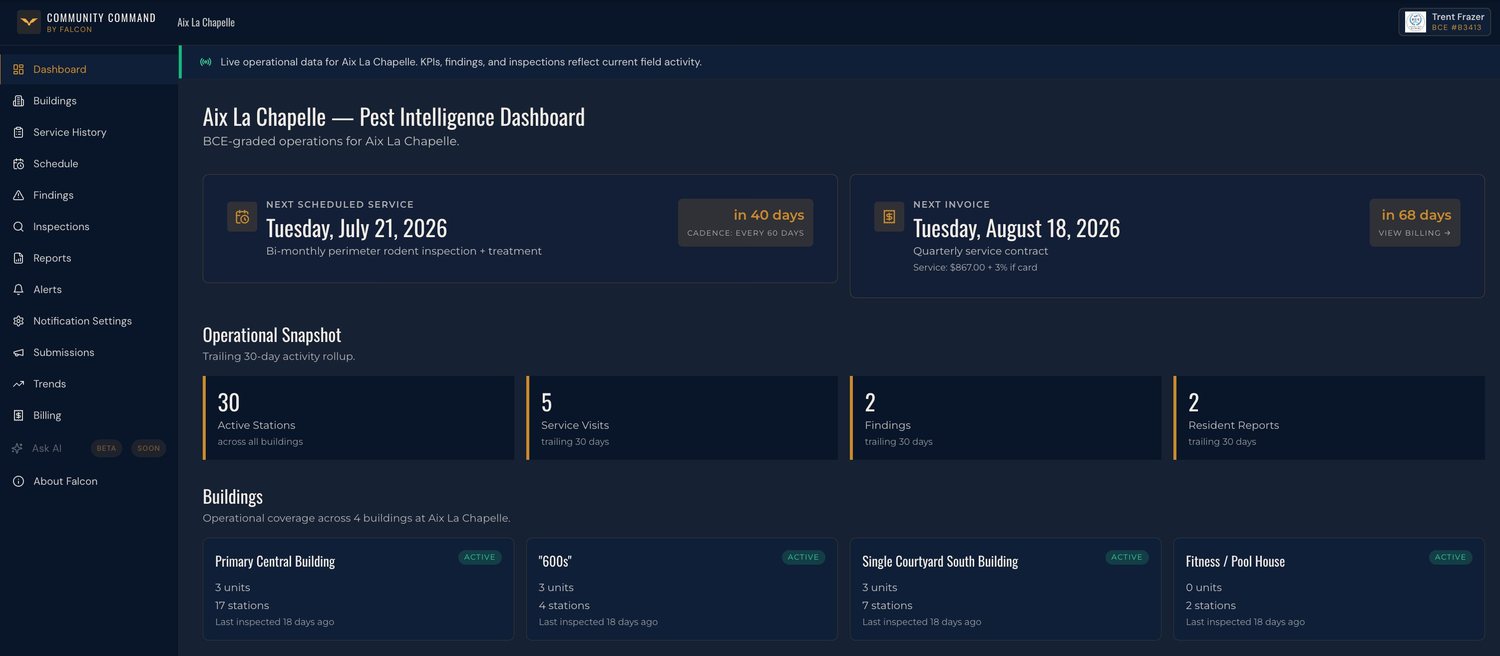
Every Falcon program includes your own portal. It's how the transparency stops being a promise and becomes something you can open on your phone.

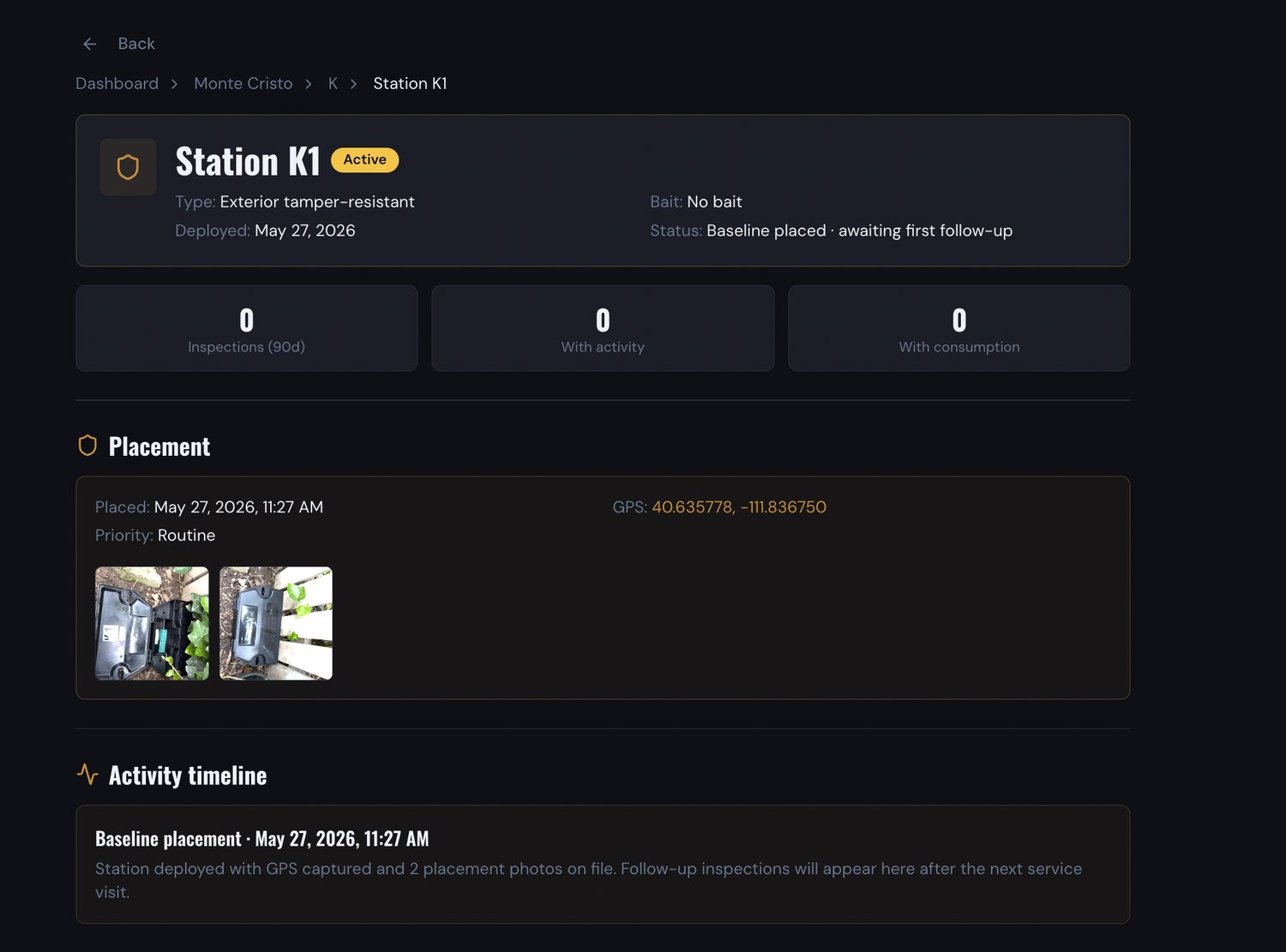
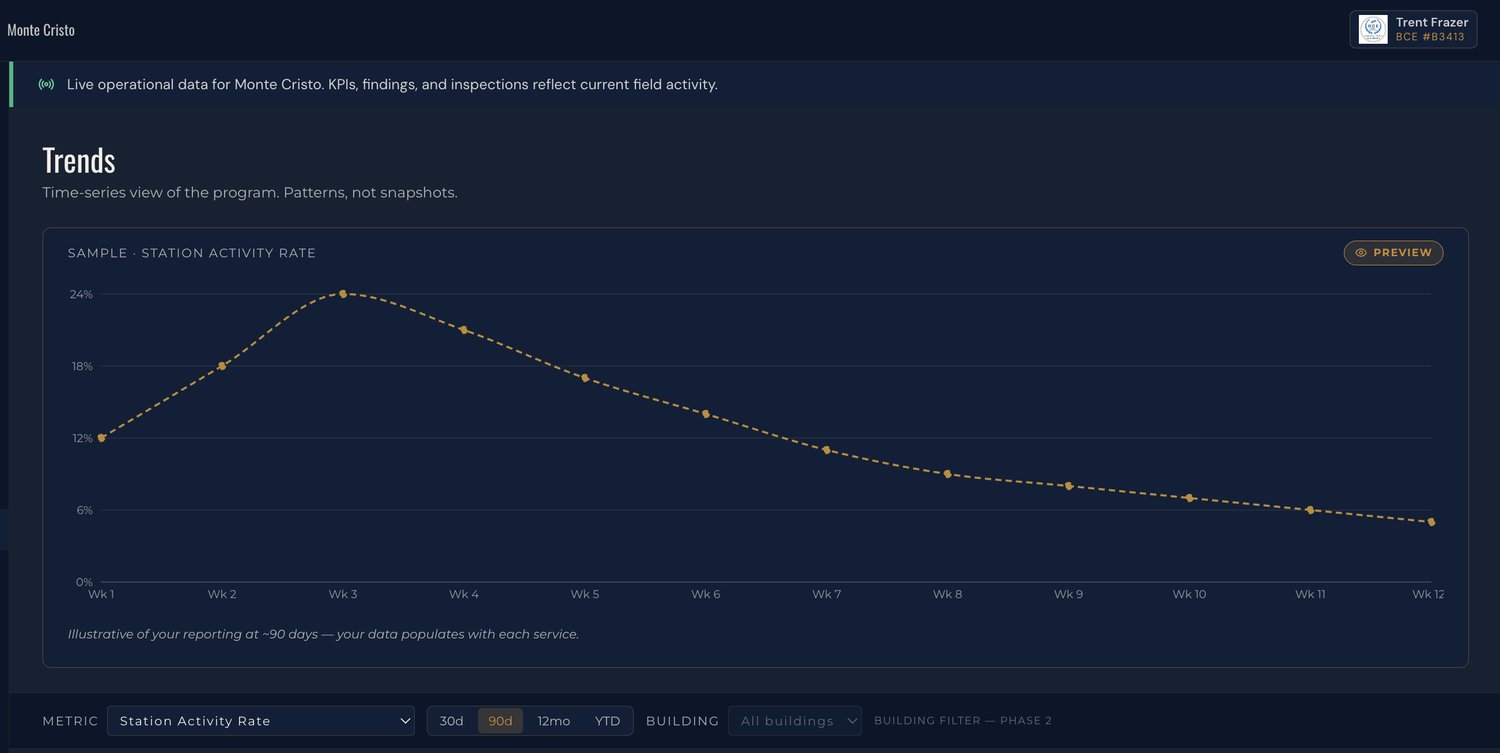
Every visit, every station is photographed with GPS coordinates and a timestamp. You click a building, then a station, and you see exactly what it looked like — current and historical — with the bait consumption tracked over time as charts and trends. And when an inspection or audit comes up and someone needs the full service record, that's one click to export. That's the question Myrna raised on the walk, and it's built in.

Community Command dashboard
Your dashboard — property status, pressure, and activity at a glance.Illustrative of your reporting
Community Command station detail with placement photos
Open any station — its placement photos, GPS coordinates, and every inspection on record.Illustrative of your reporting
Community Command activity and consumption trends
Activity and consumption trends over time — the program's trajectory, exportable for any audit.Illustrative of your reporting

These views are from the live Falcon Community Command platform. Your portal is provisioned at signing and populates with Towne Storage's own photos and data starting at your first service visit.

Credential

Board-Certified Entomologist

Trenton Frazer, BCE #B3413
BCE #B3413 seal

When you contract Falcon Pest Control, the IPM protocol on your property is personally specified, supervised, and quality-audited by a Board-Certified Entomologist. This is the technical-leadership tier in the pest management industry — the same tier specified in stadium contracts, food-processing audit work, and government IPM programs.

CertificationBoard-Certified Entomologist (BCE) #B3413
Issuing BodyEntomological Society of America (ESA) — the U.S. authority on entomological credentialing
SpecialtyGeneral Entomology
Active Population~440 active BCEs in the U.S. — less than 0.1% of practicing pest control professionals
Utah StandingTrent Frazer is one of four practicing BCEs in Utah, and the only one in independent private practice.
EducationMS Entomology, University of Florida (2015)
Industry Experience21+ years; former VP Operations and Senior Director of Quality Assurance at a nationwide pest control company — responsible for QA across 80+ operations centers serving 640,000+ customers
Recertification3-year cycle ending 2027 — 24 CEU minimum, currently on track

What this means for your property

The protocol design for Towne Storage is BCE-authored. The technicians who execute the work follow that protocol exactly — every station placement decision, every chemistry rotation, every wasp scouting interval is specified in writing and audited monthly. You are not contracting a pest control service vendor that happens to have a credential. You are contracting a credentialed protocol that includes service execution.

Every page of this proposal carries the BCE #B3413 seal. The signature converts 'pest service' into 'credentialed program design.'

UDAF Commercial Applicator License #4001-16378 (Structural, WDO, Lawn & Ornamental, Vertebrate) · UDAF Commercial Business License #4000-000021793 · Insured: Kinsale GL + CPL + Excess ($4M tower), Lloyd's Syndicate 609 E&O · Certificate of Insurance on request.

The bottom line

So here is what this program is priced to deliver. The one you have now is putting black widows into the units your tenants trust you with, and failing to hold back the rodents that a property ringed by open fields will always attract. This program is built to do the opposite — to drive the widow population down and hold it there, and to give Towne Storage rodent control that finally holds the line.

The result I'm pricing for is the only one that matters: a tenant rolls up their door and finds their belongings exactly as they left them — no widow on the box, no gnaw marks from the mice and rats a bargain contract was never staffed to stop. Right now, you're paying for the opposite of that, every month. This program is designed to bring that phase to an end.

Contract terms

Plain terms. No surprises.

Term
Month-to-month. No minimum term, no long-term contract.
Cancellation
Cancel any time with 30 days' written notice. No early-termination fee.
Setup
No setup fee. Initial placement of all 48 stations is included.
Billing
Rodent program billed monthly at the current cadence rung. Black widow and gopher work billed per visit as scheduled.
Price lock
Rates held for 36 months, then adjusted no more than 3–6% annually by index.
Warranty
On-program reservice within two business days for covered pests at no additional charge. This is a service commitment, not a guarantee of zero pests.
Carve-outs
Yellow jackets, bald-faced hornets, and concealed/void-nesting wasps; German cockroach; bed bugs. Each assessed and quoted separately on discovery.
Notice & records
7-day pre-application notice per UDAF R68-7-16(4); application records retained 2+ years per R68-7-12. Control language follows R68-7-20 — we commit to documented control, not absolute eradication.
Governing law
State of Utah.

Station Ownership, Replacement, and Damage

All bait stations, interior monitoring devices, and station hardware deployed at Towne Storage remain the property of Falcon Pest Control throughout the term of this Agreement and may be removed by Falcon upon contract termination.

Falcon will absorb the cost of station replacement at no charge to Towne Storage for the following causes: (a) wear, tear, and age-related degradation of station hardware; (b) damage caused by Falcon service personnel; (c) manufacturer defect; and (d) severe weather, flood, fire, or other acts of God, subject to good-faith negotiation for catastrophic events per the Force Majeure provision below.

Towne Storage will be billed at the published replacement rates below for station replacement required by the following causes: (a) theft, vandalism, or destruction by residents, guests, invitees, or any non-Falcon party; (b) damage by Towne Storage-contracted third-party vendors, including but not limited to landscaping, snow removal, pressure washing, HVAC, painting, or other contractors performing work on the property; (c) vehicle damage in loading docks, parking interfaces, or other vehicular zones; (d) unauthorized removal, relocation, or modification by Towne Storage personnel; and (e) disposal of Falcon stations in Towne Storage waste streams.

Interior multi-catch station $25 Exterior bait station $35 Dedicated-trip dispatch fee $25

Goodwill Provision. Falcon will absorb the first station replacement of any cause at no charge to Towne Storage during the first twelve (12) calendar months of service. The provision applies once across all station types. From month thirteen (13) forward, the full framework above applies to every incident.

Documentation. Falcon photographs every station with GPS coordinates and timestamp at every scheduled visit and logs the record in the Falcon Community Command portal. Towne Storage retains read access to the full station archive throughout the engagement. Replacement billing references the portal incident record as the contractual source of truth.

Force Majeure. Damage caused by severe weather, flooding, fire, earthquake, civil disturbance, or other catastrophic event is handled mutually in good faith. Neither party bears automatic obligation for stations damaged in such events; replacement scope and timeline will be negotiated case-by-case.

Ready when you are

Authorization

Tap the work you'd like to move forward with, then authorize. Nothing here locks you in beyond 30 days — and if the budget needs a different shape, call me before you authorize.

Rodent Treatment Program — 48 stations
$349/mo → dynamic cadence → $160/mo floor
Black Widow Remediation
$564 initial knockdown · $215/visit quarterly maintenance
Gopher Control
$345 initial · $215 follow-ups as needed
No signature needed — a click is all it takes. Or call (385) 412-9660.